High-Value vs Low-Value Payment Systems: Settlement Mechanisms and Market Infrastructures
Financial systems differentiate payment flows into two foundational categories: High-Value Payment Systems (HVPS)—often termed wholesale or large-value systems—and Low-Value Payment Systems (LVPS)—commonly referred to as retail payment systems.
While these terms suggest a simple division based on transaction size, the true architectural differences lie in their economic purpose, credit risk models, liquidity mechanisms, and systemic importance. High-value systems protect financial stability by minimizing settlement risk for wholesale transfers, whereas retail systems are optimized to process massive volumes of consumer and commercial payments efficiently.
Deconstructing Common Misconceptions
Payment engineering discussions often oversimplify how clearing and settlement work. Before reviewing specific systems, integration architects must separate three distinct dimensions: transaction value, processing speed, and settlement mechanism.
1. "All high-value payments settle instantly via RTGS"
While many wholesale systems operate on a Real-Time Gross Settlement (RTGS) basis, several premier high-value systems do not. The prominent example is CHIPS (Clearing House Interbank Payments System) in the United States, operated by The Clearing House. CHIPS is a private-sector high-value system that settles wholesale interbank transfers using a continuous, real-time bilateral and multilateral netting algorithm that matches instructions throughout the day, supported by pre-funded participant balances at the Federal Reserve Bank of New York to eliminate intraday credit risk.
2. "Instant consumer payments imply instant gross interbank settlement"
A payment that appears instant to an end user does not necessarily settle on an instant gross basis between banks. Payment architectures differentiate consumer clearing speed from interbank settlement finality:
- Deferred Net Settlement for Instant Rails: In the UK, the Faster Payment System (FPS) provides immediate funds availability to receiving customers within seconds. However, interbank settlement between Directly Connected Settling Participants occurs on a Deferred Net Settlement (DNS) basis across the Bank of England's RTGS system three times each working day, secured by pre-funded cash collateral and participant Net Sender Caps. Similarly, in India, while the Unified Payments Interface (UPI) executes real-time customer transfers, interbank obligations are settled periodically in net batches across the Reserve Bank of India's RTGS infrastructure.
- Instant Gross Settlement in Central Bank Money: Conversely, systems such as the Eurosystem's TIPS and EBA CLEARING's RT1 settle each individual SEPA Instant Credit Transfer on a real-time gross basis in central bank funds 24/7/365 with immediate interbank finality.
3. "Retail payments cannot pose systemic risk"
Although an individual retail transaction (like a grocery purchase or utility bill) cannot disrupt a bank, retail infrastructures handle massive aggregate daily values. The Committee on Payments and Market Infrastructures (CPMI) at the Bank for International Settlements (BIS) specifically designates Systemically Important Retail Payment Systems (SIRPS). An operational outage or liquidity freeze at a major retail clearing hub can halt commercial trade, disrupt payroll, and trigger cascading liquidity stress across the banking network.
4. "SEPA is a single settlement system"
SEPA (Single Euro Payments Area) is not a settlement system or a clearing house. It is a regulatory harmonisation initiative and a collection of payment schemes (SCT, SDD, SCT Inst) designed by the European Payments Council (EPC). Settlement of SEPA payments takes place across various competing and cooperating Clearing and Settlement Mechanisms (CSMs):
- STEP2 (EBA CLEARING): Processes bulk SEPA Credit Transfers and Direct Debits using a Continuous Gross Settlement (CGS) model, settling individual instructions continuously in central bank money via a dedicated TARGET Technical Account at the ECB.
- RT1 (EBA CLEARING): Settles SEPA Instant Credit Transfers continuously on a transaction-by-transaction gross basis in central bank funds, backed by liquidity held in TIPS.
- TIPS (Eurosystem): The European Central Bank's market infrastructure settling instant payments directly in central bank money.
The Value vs Volume Dynamic
The relationship between payment value and payment volume reflects the classic payment pyramid:
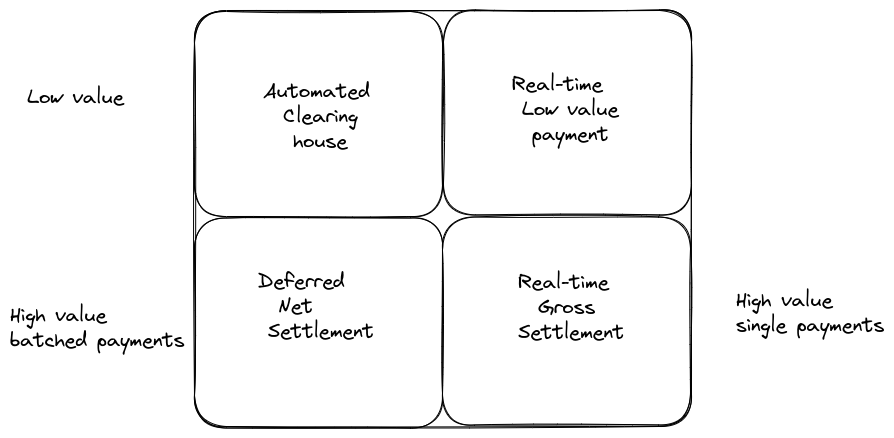
Figure 1: The payment pyramid — wholesale systems handle low transaction volumes representing the vast majority of financial value, while retail systems process massive volumes of payments with low individual values.
- High-Value Streams: Account for a very small proportion of total transaction volume across an economy, but represent the overwhelming majority of aggregate monetary value transferred.
- Low-Value Streams: Account for the vast majority of transaction volume, yet represent a relatively modest share of total monetary value.
High-Value Payment Systems (HVPS)
HVPS are the backbone of central bank operations, interbank money markets, foreign exchange transactions (e.g., through CLS), and large corporate treasury transfers. Because individual payments can be substantial, finality and liquidity management are paramount.
Key Characteristics:
- Strict Finality: Settlement is irrevocable and unconditional, typically settled in central bank reserves.
- Direct Central Bank Oversight: Designated as systemically important financial market infrastructures (FMIs) subject to CPMI-IOSCO Principles for Financial Market Infrastructures.
- Membership Rules: Restricted to licensed deposit-taking financial institutions, clearing houses, and central banks.
- Absence of Caps: Generally enforce no upper ceiling on monetary amounts.
Prominent Wholesale Systems:
- Fedwire Funds Service (United States): Owned and operated by the Federal Reserve Banks. A pure RTGS system where wholesale funds transfers are settled individually and immediately in central bank funds.
- CHIPS (United States): Owned and operated by The Clearing House. The premier private-sector high-value USD clearing engine, settling transactions continuously throughout the day using a real-time matching and netting algorithm backed by pre-funded accounts at the Federal Reserve Bank of New York.
- T2 (Eurosystem): The Eurosystem wholesale payment system that officially replaced TARGET2 on 20 March 2023. T2 introduces ISO 20022 native messaging and optimizes liquidity management across TARGET Services (T2 RTGS, Central Liquidity Management, TIPS, and T2S securities settlement).
- CHAPS (United Kingdom): The UK's high-value payment system operated by the Bank of England, settling high-value sterling payments in real time across central bank reserve accounts.
- Lynx (Canada): Canada's high-value payment system operated by Payments Canada, replacing the legacy Large Value Transfer System (LVTS) with an ISO 20022 RTGS architecture.
Low-Value Payment Systems (LVPS) & Retail Rails
Retail systems handle consumer-to-business (C2B), business-to-consumer (B2C), person-to-person (P2P), and general commercial operations. Transaction types include payroll direct credits, regular subscription direct debits, point-of-sale card payments, and e-commerce transfers.
Key Characteristics:
- High Throughput: Designed for horizontally scalable processing of millions of transactions per day.
- Standardized Message Formats: Transitioning globally to ISO 20022 schemas (such as
pain.001credit initiation,pacs.008interbank transfer, andpacs.003direct debit). - Accessible Entry: Broad participant reach, including commercial banks, credit unions, neo-banks, and authorized non-bank payment service providers (PSPs).
- Value Thresholds: Often enforce upper limits per transaction to mitigate consumer fraud and operational exposure.
Settlement Architectures in Retail Payments:
- Continuous Gross Settlement (Bulk Processing with Gross Settlement):
- STEP2 (Pan-European): Operated by EBA CLEARING, STEP2 is a Pan-European Automated Clearing House (PE-ACH) for SEPA Credit Transfers and Direct Debits. Rather than using end-of-day net settlement, STEP2 operates on a Continuous Gross Settlement (CGS) model (completed in July 2022). While payments are transmitted in bulk files, individual payment instructions settle continuously in central bank money using dedicated TARGET Technical Accounts held at the ECB via the T2 Ancillary System Interface (ASI).
- Scheduled Deferred Net Settlement (DNS):
- ACH Network (United States): Composed of two operators—the Federal Reserve (FedACH) and The Clearing House (EPN)—settling direct deposits and direct debits in scheduled settlement windows throughout the banking day.
- NEFT (National Electronic Funds Transfer, India): Owned and operated by the Reserve Bank of India (RBI). NEFT operates on a Deferred Net Settlement (DNS) basis across 48 half-hourly batches operating 24 hours a day, 365 days a year.
- Bacs (United Kingdom): The UK's legacy bulk clearing service for direct credits and direct debits, operating on a three-day processing cycle.
- Retail Instant Payment Networks:
- FedNow (US Federal Reserve) & RTP (The Clearing House): 24/7/365 US real-time clearing rails for instant consumer and business disbursements.
- Faster Payment System (FPS, United Kingdom): Provides immediate funds availability to end users while settling net interbank obligations three times daily across the Bank of England's RTGS.
- RT1 & TIPS (Europe): EBA CLEARING's RT1 and the Eurosystem's TIPS provide round-the-clock real-time gross settlement in central bank money for SEPA Instant Credit Transfers.
- Pix (Brazil) & UPI (India): National instant retail overlay systems facilitating consumer-to-business and person-to-person transfers across participating commercial banks.
Comparative Matrix: High-Value vs Low-Value Payment Systems
The following table contrasts verified market infrastructures across jurisdictions, detailing their settlement models and operational authorities:
| System / Infrastructure | Jurisdiction | Classification | Settlement Mechanism | Value / Volume Profile | Governing Entity / Operator |
|---|---|---|---|---|---|
| Fedwire Funds Service | United States | High-Value (HVPS) | Real-Time Gross Settlement (RTGS) | Wholesale, high value | Federal Reserve Banks |
| CHIPS | United States | High-Value (HVPS) | Continuous Multilateral Netting & Matching | Wholesale, high value | The Clearing House (TCH) |
| T2 (replaced TARGET2) | Eurozone | High-Value (HVPS) | Real-Time Gross Settlement (RTGS) | Wholesale, central bank reserves | Eurosystem / European Central Bank |
| CHAPS | United Kingdom | High-Value (HVPS) | Real-Time Gross Settlement (RTGS) | Wholesale, high value | Bank of England |
| FedACH / EPN | United States | Low-Value (LVPS) | Deferred Net Settlement (Scheduled Batches) | Retail & commercial bulk | Federal Reserve & The Clearing House |
| NEFT | India | Low-Value (LVPS) | 48 Half-Hourly Batches (DNS, 24x7x365) | Retail & commercial funds transfers | Reserve Bank of India (RBI) |
| STEP2 | Pan-European | Low-Value (LVPS) | Continuous Gross Settlement (in central bank funds via TARGET/T2) | High volume SEPA bulk payments | EBA CLEARING |
| Faster Payments (FPS) | United Kingdom | Retail Instant | Deferred Net Settlement (3 daily cycles over Bank of England RTGS) | Retail & commercial payments | Pay.UK |
| RT1 | Pan-European | Retail Instant | Real-Time Gross Settlement (in central bank funds via TIPS) | Instant SEPA payments (SCT Inst) | EBA CLEARING |
| TIPS | Eurozone | Retail Instant | Real-Time Gross Settlement in Central Bank Money | Instant SEPA payments (SCT Inst) | Eurosystem |
Summary for Integration Engineers
When designing financial systems or integrating ISO 20022 payment pipelines:
- Distinguish clearing speed from interbank settlement: A payment can clear instantly to a retail customer while settling between participating banks later via deferred net settlement; conversely, real-time gross settlement rails settle each transaction immediately with interbank finality.
- Account for liquidity management differences: Wholesale HVPS integrations require real-time collateral monitoring and liquidity scheduling (such as T2 Central Liquidity Management), whereas retail batch systems require reconciliation across clearing windows.
- Verify message format specifications: While wholesale systems (T2, Fedwire ISO migration, CHAPS) and retail systems (SEPA, Faster Payments) share ISO 20022 roots, their specific message implementation guidelines (MIGs), usage rules, and mandatory fields differ fundamentally.
Authoritative Sources
- EBA CLEARING: STEP2 Settlement Overview — Official documentation of the Continuous Gross Settlement (CGS) model for STEP2 SEPA services.
- Pay.UK: Faster Payment System Overview — Operational parameters and deferred net settlement model over the Bank of England RTGS.
- The Clearing House: CHIPS Network Overview — Operational framework and continuous matching/netting parameters for CHIPS.
- Reserve Bank of India (RBI): FAQs on National Electronic Funds Transfer (NEFT) — Official batch schedules and operational framework for NEFT.
- European Central Bank: Successful Launch of T2 Wholesale Payment System — Press release detailing the March 2023 replacement of TARGET2 by T2.